October 22, 2026
Part Two: They Believed the Name. They Ignored The Person Who Knew.
I made my own map, built my own ladder, and started building Healveda Care
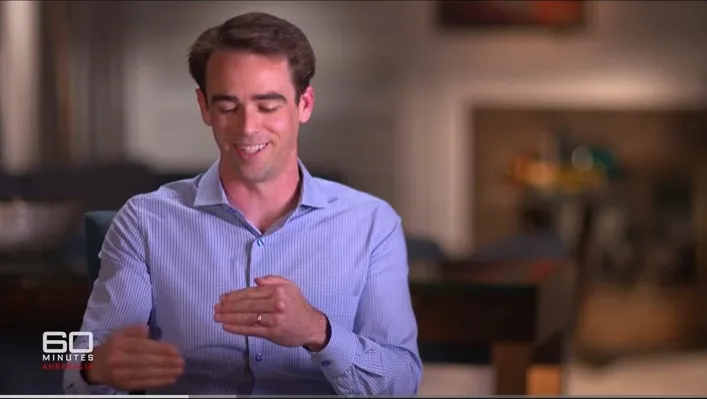
Tyler Shultz in 60 Minutes Australia · Image from the supplied broadcast screenshot
By Sweta Patel | Founder, Healveda Care
There Was No Map. I Made One.
I was never handed a ladder. I had to build one.
Every doctor who dismissed my symptoms taught me how easily a patient can disappear when the answers are not obvious. Every clinic that turned me away left me with another question no one was taking responsibility for answering. My conditions were complex. I was not the patient who could be given a routine answer and sent home with everything resolved. My care took time, attention, and more than one specialty. It did not fit the quick, tidy, profitable story health care businesses like to tell. I cannot establish that money drove a particular refusal. I can tell you that too often I left having to decide what to try next by myself.
I cannot tell you what every physician was thinking. I can tell you what happened when the help I needed was not there. I had to keep searching. Keep learning. Keep making calls. Keep pulling pieces of information together that belonged in one conversation but lived in six different offices.
I had to create my own map because nobody had given me one. Then I had to build the ladder I would need to climb out of situations I never chose.
That map was not a diagram in a presentation. It was the list of people who would answer a question, the dates that mattered, the notes that might prevent another lost appointment, the questions I had to ask before a treatment, the reasons a referral had stalled, the next step when a clinic said no. It was learning when to insist, when to look elsewhere, when to ask for another opinion, and when to admit that I had reached the limits of what I could manage alone.
Nobody calls that founder training. Nobody gives you a certificate for it. Yet those years taught me what people with complex conditions are forced to become: their own scheduler, advocate, information manager, care historian, and often the only person checking whether the plan is still a plan.
I had to live with the strain of being unwell while doing all that work. I also had to find ways to keep functioning. I produced real improvements in my own health through persistent work and the care I was able to obtain. I built strength and routines around what my body could manage. There were setbacks, and there were steps forward. I do not present my personal progress as a clinical study. I present it as proof of how much unpaid effort one patient can be required to supply before she can get on with her life.
And then I became a founder.
You might imagine the hard part was behind me. I knew the problem intimately. I wanted patients with overlapping conditions to have something more useful than another list of phone numbers. I began translating that knowledge into a care-coordination business. I recruited developers. I worked on the app. I thought through patient needs, how information should be shared, what professionals would need to see, and what should happen when nobody answers a message. I pursued funding. I built relationships one by one.
I did not suddenly acquire a famous mentor. I did not receive a list of the investors I was supposed to know. I did not get to borrow a celebrated person’s credibility until the world decided mine had value.
The same demand followed me from medicine into entrepreneurship: find someone more powerful who will say you are worth listening to.
In a clinic, the question was whether another doctor would take my symptoms seriously. In the investment world, the question sometimes seems to be whether someone already inside the room will make the introduction. It can be easier for a founder to get a conversation by pointing to a prestigious adviser than by pointing to the years she spent learning where patients are left without help.
I reject the idea that a person’s authority has to arrive through somebody else. Mine was built through the calls nobody made for me, the questions I had to ask again, and the work I continued doing when I had no guarantee that it would succeed.
That authority has a limit. It tells me what I have lived, what I have noticed, what I can bring to the design of a service. It does not make me the physician for every person with an autoimmune condition. It does not validate a product we are still developing. It should, however, be enough to earn a serious conversation about the business I am building.
I am not asking investors to award points for pain. I am asking them to recognize what it took to produce work in its presence. If they want to know whether I can find a way through difficult conditions, I have had a lifetime of practice. If they want to know whether Healveda Care can scale, we can talk about the product, the team, the costs, the demand, and what proof comes next. Both conversations belong on the table.
I built the map. I built the ladder. Now I am building something so fewer patients have to do it all alone.
A Directory Cannot Coordinate Care
When a clinic sent me elsewhere, what I needed was not always another search result. I needed someone to help turn the instruction into an appointment, a response, or a next step I could actually take. That memory guides what I ask developers to think about.
Digital health care has an abundance of ways to present people with choices. Patients can search for professionals, compare services, schedule appointments, view content, join communities, and collect information. Many of these functions are useful. Still, putting clinicians into the same searchable place does not necessarily make them a team. A directory answers who might be available. Coordination must answer what happens after the patient meets them.
Imagine someone who finds an excellent endocrinologist through a platform and an excellent rheumatologist through the same platform. The two providers may have different records, different systems, different assumptions about the patient’s treatment, and no established channel for discussing a shared issue. The platform may have succeeded as a marketplace and failed to change the work of care. Counting both appointments as proof of coordination would obscure the problem.
Healveda’s intended distinction is to move beyond discovery toward a dependable way for people to communicate and follow through across participating professionals. That means protocols describing how information is gathered, when consent is required, how responsibilities are assigned, what information needs clinician confirmation, and what happens when recommendations conflict. It means a patient care plan that is useful because participants can act upon it, rather than one that looks impressive because it contains many fields.
This design also raises honest limits. Independent clinicians cannot be made to coordinate simply because a technology vendor wants them to. Participation requires professional incentives, compatible workflows, reasonable documentation demands, and applicable legal and privacy requirements. A clinician with twelve minutes between appointments will not adopt a system that introduces another hour of unpaid administration unless the benefit is compelling and the workflow can be sustained.
That is why the commercial question and the clinical question must be studied together. We need to know not only whether a task can be completed inside a product, but whether real practices will use that product consistently. We need to know which care-coordination work require human labor and who pays for it. We need to know whether a patient actually experiences less confusion. We need to know whether physicians perceive the information as reliable enough to use.
I am not trying to build the largest collection of health care profiles. It is to create a service in which participation has a definable meaning and produces a result that can be evaluated. If that takes longer to build than a directory, it is still the more important work.
My developers can build a polished app. Their work matters. But I have been the patient who received a message and still did not know whether anyone would help. The software has to serve that person, not merely impress the people watching a product demo.
One of the easiest errors in digital health is to equate the existence of software with the delivery of care. A product can have a polished user interface, sophisticated architecture, dashboards, reminders, messaging, and a growing number of accounts while leaving the underlying process unchanged. Software may make a problem more visible without making anyone responsible for solving it.
A coordination service needs a plan for how the service will run. Technology is the way that supports that service. The design must specify which participants do what, what data are needed, which actions require clinical judgment, how consent and access are controlled, and how completion is demonstrated. It should include practical protocols for the moments when everything goes wrong: an unavailable specialist, a missing record, a patient who cannot respond promptly, an ambiguous instruction, an incorrect medication list, or a clinician who disputes a previous recommendation.
A good engineer can create a system to record an action. A good clinical operations team must define what the action means. A good privacy team must determine what information may be shared and with whom. A good product manager must understand the burden on patients and clinicians. A strong company must integrate these capabilities rather than asking any single discipline to substitute for the rest.
I am building with developers because the underlying work matters. Reliability, access controls, audit trails, systems that can share data, accessibility, and thoughtful workflows cannot be improvised at the end. But code alone is not Healveda’s reason someone would use it. The reason someone would use it is a proposed improvement in how care is organized and experienced. The software should make that improvement feasible, visible, and sustainable.
It also changes what we should celebrate. Completing a design sprint is a development milestone. Releasing an interface is a product milestone. Establishing a signed clinical partnership is an operating milestone. Demonstrating a reduction in unresolved handoffs under an appropriate evaluation design would be an outcomes milestone. They are different achievements. We should not let one stand in for another.
For investors, this is a useful way to evaluate the company. Ask to see a live care process with sensitive information appropriately protected. Look at a workflow from initiation through resolution. Ask which steps are automated, which are performed by trained people, and which depend on outside clinicians. Look for the unanswered questions. A founder who can point to the limits of a prototype is giving you more useful information than one who insists every feature is already revolutionary.
If a patient must call three offices to find out who promised the referral, nobody should mistake those calls for a functioning service. I have made those calls. In Healveda Care, I want the next step to have an actual owner, not just a place on a screen.
Accountability is often treated as an abstract virtue. In coordination, it can be made practical. AHRQ’s research specifically calls for establishing accountability and clarifying responsibility among participants as a coordination activity. That does not mean every failure has a single person to blame. It means a system should make the expected work explicit enough that participants can see when it has not happened. [8]
Start with a referral. Who requested it? Who sent the required information? Was the receiving office able to act? Did the appointment occur? Did the referring clinician receive the outcome? Was the patient told what happens next? Each question describes a point at which a pathway can succeed, stall, or fail. Without shared visibility, each office may believe it did its part while the patient remains in the gap.
Now consider conflicting guidance. One clinician recommends a change while another advises caution. A patient should not be expected to act as a substitute adjudicator between two medical professionals. The coordination service should help communicate the conflicting recommendations, identify the responsible clinicians, and track clarification. It must not invent an answer. That difference matters: software can facilitate a discussion without claiming authority to practice medicine.
Finally, consider a patient whose circumstances change. An insurance transition can invalidate earlier assumptions about network access. A transportation problem can disrupt follow-up. A new diagnosis may alter priorities. A responsible system should allow the care plan to be revisited and its dependencies reevaluated. A fixed checklist cannot faithfully represent a changing life.
For Healveda, accountability will need to be translated into service standards, staffing decisions, escalation procedures, and transparent reporting. If an issue is outside the platform’s remit, the patient should be told. If a partner cannot accept the task, that fact should be visible. If a service is delayed, the reporting should not disguise delay as progress. In a health care company, those details have more ethical weight than the number of screens in the app.
A skeptical investor should press hard on the cost of this work. Who will follow up when a provider does not respond? How many cases can a coordinator safely manage? What documentation is needed? What exceptions require clinical escalation? Those are not obstacles to the thesis. They are the questions that can turn a claim about accountability into an actual way to run the service.
Because I have spent so much time depending on other people to get details right, I care about what happens when software gives a patient false reassurance. A pleasant screen cannot replace a returned call. A checkmark cannot replace a completed referral.
Every health care company can say that safety matters. The harder task is to specify the hazards the product can create, reduce, and leave untouched. A coordination platform may reduce some risks by improving information flow. It may introduce others through inaccurate data, overconfident automation, delayed escalation, inappropriate sharing, ambiguous responsibility, or an interface that encourages a patient to rely on a task that nobody is monitoring.
The first safety rule is knowing what the platform must not claim. Healveda should not claim to diagnose, prescribe, interpret complex findings independently, or manage emergencies without the necessary professional authority, validated capabilities, and applicable regulatory pathway. Clinical decision support functionality must be assessed against the relevant rules. The FDA’s January 2026 guidance explains that some clinical decision support software functions fall outside the medical-device definition, while other software functions remain subject to FDA oversight. Classification depends on actual functionality and intended use; a company name or marketing description does not settle it. [9]
The second rule is to tell people who is doing what. Patients must know which information is educational, which is self-reported, which has been reviewed, and which guidance comes from a licensed professional. Clinicians must know what they are being asked to do and what information they can rely upon. Staff must know when an issue requires escalation and what the limits of their training permit.
The third rule is to take mistakes seriously. A patient who experiences confusion, an incorrect notification, a missed handoff, or an unexpected exposure of information should have a clear route to report the problem. Reports should be analyzed, categorized by severity, and connected to corrective action. The company should study not only what the platform did, but what the patient reasonably understood it would do.
The fourth commitment is proof that matches the risk. Not every scheduling reminder needs a randomized trial. A system that influences clinical decisions, however, may require much deeper validation and regulatory review. The higher the potential harm, the higher the burden of proof. The level of evidence should match the claim and the foreseeable results of being wrong.
Theranos demonstrated why a declaration of good intentions cannot compensate for unreliable medical claims. For Healveda, the response must be practical: narrow claims, clear boundaries, technical safeguards, clinical governance, and independent scrutiny. Safety cannot reside solely in a founder’s conviction. It must be built into decisions the company makes when that conviction is tested.
What a Product Demo Cannot Show
The hardest work in care coordination is less photogenic. Someone has to decide how a referral will be handed from one clinician to another. Someone has to determine what counts as completed follow-up. Someone has to design permissions so that a patient can share necessary information without surrendering unnecessary privacy. Someone has to ask whether the person receiving the message can interpret it in context. Someone has to calculate the labor needed when automated reminders cannot resolve a problem. Someone has to decide what happens on a Friday afternoon when a patient is waiting for a response that will not arrive before Monday.
Those decisions rarely become the headline of a fundraising announcement. They are among the details that determine whether a care service actually functions. A marketplace can show a provider profile immediately. A coordination company has to earn the right to say that participating providers communicate in a dependable way. It must design for the exceptions, not simply the ideal path. It must understand which parts of the process are under its control and which are not.
This is why an investor who measures only how quickly features are released can miss whether a product is safe and useful. Shipping quickly is useful if the company has defined what it is shipping and how the result will be evaluated. Shipping quickly can also make a weak process available to more people before anyone understands its failure points. In health care, the speed of release must be weighed against the results of error, confusion, and misplaced reliance.
Healveda Care is being built with developers because the technology matters. But the question I want to answer is not whether we can assemble attractive screens. It is whether the system can support useful action across the care process. Can a patient and participating professional see what needs to happen next? Can responsibility be assigned rather than assumed? Can a missed handoff be identified without making the patient reconstruct the entire episode? Can a person understand when a task is pending, completed, declined, or outside the service’s scope?
Those are not glamorous questions. They are the questions that build a credible service. A founder who can answer them with an honest operating design has accomplished something that deserves review even if a celebrity has never mentioned the company. An investor who refuses to look because the pitch does not produce immediate excitement may be selecting for excitement rather than the work the investment is supposed to finance.
I want the unglamorous work counted. I want the people who perform it counted. I want investors to understand that clinical coordination does not become less important because it is difficult to put into a short video. The problems patients carry between appointments are substantial precisely because they are dispersed across organizations, schedules, records, responsibilities, and budgets. Making that work visible is part of solving it.
A Warm Introduction Should Not Be the Price of Entry
I understand why investors prefer introductions from people they trust. Their inboxes are full. A recommendation can save time. Some referrals are excellent. Good relationships have helped countless honest companies grow.
Still, I cannot ignore what happens to a founder outside that circle. She sends the work and hears nothing. She sends an update and hears nothing. She tries another address, a fund’s general inbox, a conference, a grant, a mutual contact who may know a mutual contact. Meanwhile, someone with the right introduction can sometimes reach the same people in a single message.
But I can describe the pressure that this culture creates. You begin to wonder whether your first task is to build the company or to find a powerful person who will persuade other powerful people to look at it. You begin to see introductions treated almost as proof of quality. You feel the strange insult of having to borrow a voice when you have spent years learning what you are trying to say.
I have built Healveda Care because I know what an unanswered call can mean to someone who is ill. I am working with developers because patients need more than sympathy. They need a system designed to help them keep track of what has happened, what is pending, and who needs to respond. If we earn trust, it should come from what our service actually does. If we earn investment, it should come from a serious review of whether the company can deliver.
A founder who was forced to learn the hard way can still build an imperfect business. An investor has every right to uncover those imperfections. I would welcome a meeting that ends with hard questions. I would welcome the chance to correct an assumption, refine the product, find the right clinical advisers, prove that a workflow saves time, or discover that our early plan needs changing.
What I cannot turn into a better business is a door that never opens because I cannot produce the right intermediary.
A warm introduction should be helpful. It should not be the price of being seen.
What Healveda Care Still Has to Prove
I would rather an investor ask ten difficult questions than admire a story that sounds too good to test. I have already lived with enough unanswered questions in health care. I do not want Healveda Care to become another company where patients are expected to trust a promise nobody has proved.
The worst response to Theranos would be to replace one kind of faith with another. It would be tempting to argue that because a patient-founder has endured the problem, investors should believe whatever she proposes to solve it. I reject that argument. Personal knowledge is valuable in discovering problems and designing research. It does not establish that a product works for a broader population or that a company can sustain itself financially.
Healveda Care must be judged through milestones that match its claims. Its proposed way of coordinating care should be tested for whether people can use it and whether professionals will adopt it. Its communication protocols should be tested with participating professionals. Its approach to patient safety should be reviewed by people qualified to assess the relevant risks. Its software must be evaluated for accessibility, privacy, reliability, and usability. Its commercial plan has to identify who benefits, who pays, why they would continue paying, and how the model operates when demand grows.
For a company of this kind, I would want the evidence organized around straightforward questions. Do patients finish the tasks they set out to complete? Do they experience fewer unresolved handoffs? Are treatment-plan steps completed more consistently? Are duplicated activities identified and avoided when appropriate? Can clinicians actually work with the information they receive? Is the system saving time rather than relocating burdens? Are patients comfortable with what is shared? What happens when people stop using it?
We need to agree on what we are measuring before we announce a result. A reduced delay depends on how a delay is measured and what comparison is used. Improved coordination cannot mean only that two specialists appear in the same digital account. Greater satisfaction must be gathered using a credible method that includes people whose experiences were not positive. Economic value requires accounting for the labor and technology needed to produce the result.
This is also why a pilot matters. An early program can test whether a workflow is usable, whether users understand their responsibilities, and whether a participating organization can maintain the service. A pilot can reveal that an apparently helpful feature creates unanticipated work. It can show that a problem is more complicated than a founder initially thought. It can identify the conditions under which a model has a reasonable chance of functioning. None of those discoveries is a defeat. They are what honest building looks like.
The National Institutes of Health is not going to accept a founder’s personal conviction as proof of a service’s effects. Neither should a health care investor. The distinction I ask for is that serious clinical standards should be applied to a venture’s proposed claims, rather than invoked as a vague reason to dismiss unfamiliar founders. If the investor wants a study, specify what outcome matters and what study design would provide useful information. If the investor is concerned about reimbursement, ask for a reimbursement analysis. If the investor doubts clinician participation, ask for evidence from clinicians.
Those questions can make Healveda Care stronger. I would rather be challenged by a knowledgeable investor who names the problem than praised by someone who sees only a story. We do not need to be believed because of who knows us. We need a fair chance to show whether what we are building deserves belief.
Before You Invest, Look at the Work
If I were sitting across from an investor, I would rather begin with the difficult facts about what still needs to be built. That is a better conversation than explaining why I do not have a famous person willing to forward the deck.
If I were designing a review process in response to Theranos, I would not begin by eliminating introductions, brand names, school histories, and referrals. Those may still provide context. I would begin by putting them in their proper order. First identify the actual claim. Next identify the kind of evidence capable of verifying it. Then assess the evidence independently. Only after that should reputation, networks, and personal conviction influence the broader picture.
For a diagnostic device, the relevant questions concern analytical performance, validation, regulatory requirements, quality systems, and the difference between data gathered internally and evidence independently reproduced. A board member with an impressive career in another field cannot resolve those questions. For a care coordination platform, the questions should be whether the work can actually be done, safety, usability, clinical participation, measurable outcomes, and sustainable economics. A touching personal history cannot resolve those questions either. The standards differ because the products make different claims, not because some founders deserve easier treatment.
I would ask investors to document the moment when they decide a company is worth a closer look. Was it a referral from a trusted partner? A major customer? A credible clinical advisor? A measurable result? A unusual product design? A compelling market need? Which of these was treated as evidence, and which merely caused the team to start checking? Those are not the same thing. A referral can identify an opportunity. It cannot settle the investment case.
I would also ask what happens to a company that arrives without an introduction. Does the firm have a process to evaluate an unfamiliar founder on a defined set of indicators? Are there opportunities for a short written assessment, an open office hour, a carefully scoped pilot, or a serious meeting that does not depend on an insider? Can the firm explain what it needs to see at the next stage? Not every fund can review every application closely. A fair process does not require limitless time. It requires that the threshold for consideration be about the opportunity rather than the founder’s social proximity.
For health care, the evaluation should include people competent to test the claims. Experienced clinicians can question workflow assumptions. Patients can identify burdens hidden in a product demo. Privacy and security specialists can identify risks that a finance-oriented board may miss. Commercial operators can test reimbursement, purchasing cycles, implementation expenses, and retention. Investors should want these voices in the room before a narrative becomes too expensive to challenge.
The question for Healveda is not whether we can assemble the right names for a pitch. It is whether the right people can inspect what we have designed and find a path toward a service that works. The question for investors is whether they are willing to search for capability outside the circle that already receives their attention. Both questions require effort. Both are more useful than attaching the word visionary to whoever sounds most certain.
Judge What I Have Built, Not Whose Name I Can Borrow
Here is what I want investors to know about Healveda Care. My work began long before the app. It began with years of trying to get care that fit a body and medical history no single appointment could explain.
I began building Healveda Care with that understanding, not with a borrowed name.
There are developers involved. There is a plan for a patient-centered platform. There are people who have shown interest in the work. I have previously described a community of more than 10,000, roughly 40 experts, and more than 200 paid users across the business. Those figures are my reported business figures, not independent proof of current app usage, medical improvement, or future revenue. Investors should be able to verify the definitions, dates, and supporting documents before relying on any of them.
We are not claiming that a finished Healveda platform has already improved clinical outcomes. The product needs to be built, used, tested, and improved. The services we offer today should be distinguished from features still under development. That is how a health care company should speak when patient trust is at stake.
But none of those honest limits make the problem less real.
People with overlapping conditions still leave appointments trying to remember what one specialist needs from another. Referrals still require follow-up. Medical records still arrive in places where the patient must retrieve and explain them. It is easy for one office to finish its part and for the patient to be left managing everything between that office and the next. That is the work Healveda Care wants to reduce.
I am asking investors to consider an opportunity based on its substance. Look at the product plan. Meet the developers. Ask how we intend to handle patient consent and data protection. Ask how licensed professionals will participate and where our responsibilities end. Ask how we plan to earn revenue, what we will measure, and how we will decide whether a feature is helping anyone. Ask us to prove milestones before writing a larger check.
I welcome those questions because I have spent too much of my life dealing with the cost of systems that nobody bothered to question.
What I resist is the suggestion, spoken aloud or implied by an unanswered inbox, that none of this merits a serious look until a more famous person steps between me and the investor.
I do not want an investor to confuse that history with clinical proof. I want an investor to stop confusing the absence of pedigree with the absence of ability.
If you do not invest, tell me what the work lacks. If you think we are early, say what would change your view. If our model needs a sharper focus, tell me where the weakness lies. I can work with specific criticism. I cannot build a better product from the assumption that I must first become someone else’s protégé.
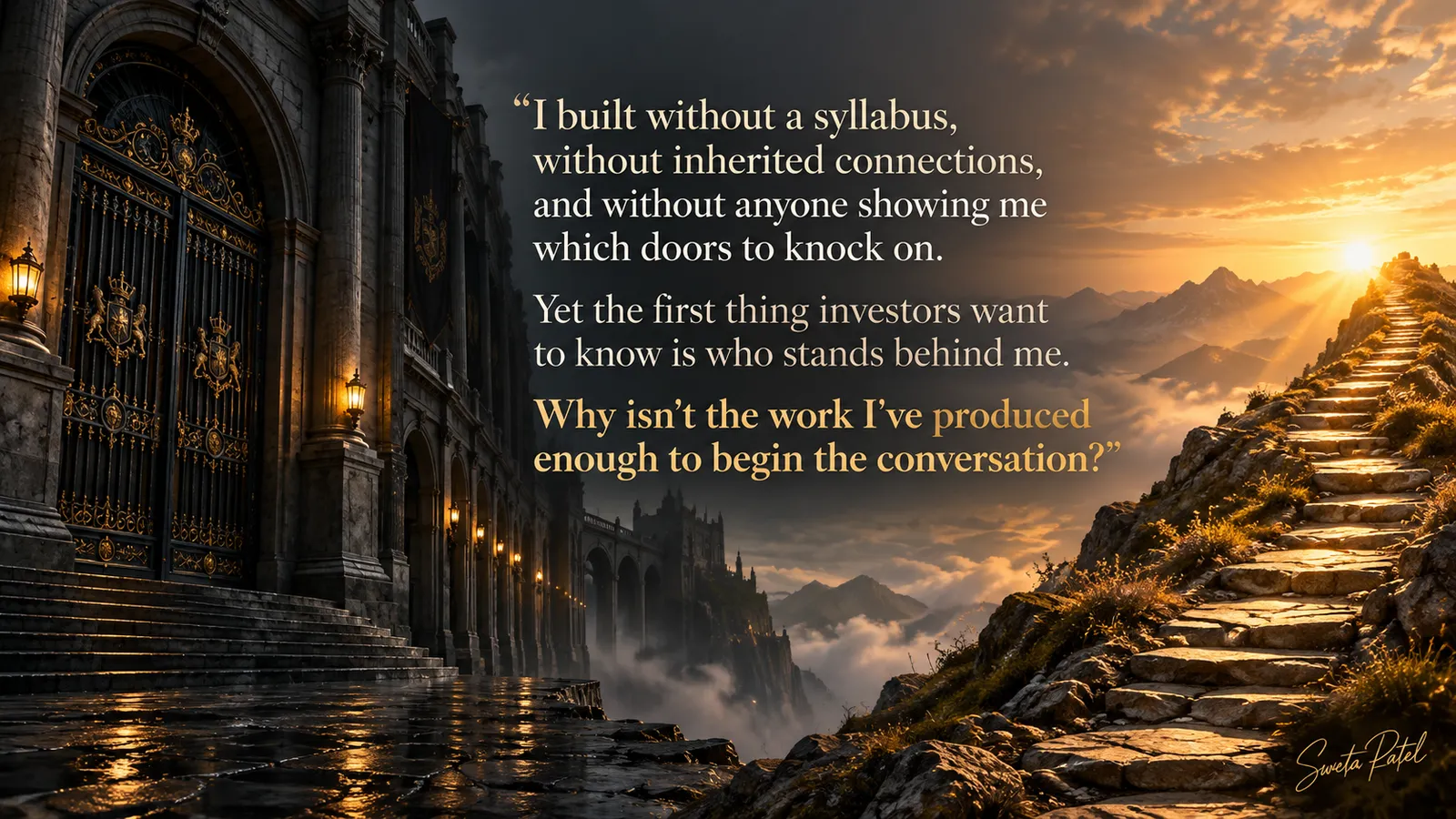
I did not climb a famous person’s ladder. I built mine.
It should not take a famous person’s permission for the work at the top of it to be seen.
The Question I Want Investors to Answer
For a medical claim, show the science. For a care service, show what happens to the patient. For a business, show how it earns enough to keep serving people. For a founder, look at the work she has done and the judgment she has shown.
That is all I want. Not a lower standard. Not a sentimental exception. The same willingness to look closely that is so often extended to someone who arrives with a powerful person’s introduction.
But I will keep asking why the first test of a founder is so often whom she knows rather than what she knows.
If a powerful introduction can make investors curious about a promise, why can’t years of firsthand knowledge, hard work, and a team already building make them curious about the person who had to find her own way?
That is not a plea for sympathy. It is a question about what investors are trained to recognize.
I did not need a famous person to tell me the problem was real. I lived it. Now judge what I am building to change it.
Sources and reporting
Theranos claims in this article draw on the reporting and primary sources below. My medical experience and the progress I describe in my own life are personal accounts. Healveda Care features still being built are plans, not finished capabilities. Business figures are founder-reported and should be checked against supporting records. No investor’s private reason for passing on Healveda has been verified.
1. U.S. Securities and Exchange Commission, Elizabeth Holmes, et al. and Ramesh “Sunny” Balwani, March 19, 2018. https://www.sec.gov/enforcement-litigation/litigation-releases/lr-24069
2. U.S. Department of Justice, Theranos Founder Elizabeth Holmes Found Guilty of Investor Fraud, January 4, 2022. https://www.justice.gov/usao-ndca/pr/theranos-founder-elizabeth-holmes-found-guilty-investor-fraud
3. U.S. Department of Justice, Elizabeth Holmes Sentenced to More Than 11 Years for Defrauding Theranos Investors, November 2022. https://www.justice.gov/usao-ndca/pr/elizabeth-holmes-sentenced-more-11-years-defrauding-theranos-investors-hundreds
4. 60 Minutes Australia, How a Theranos Whistleblower Was Betrayed by His Family, original broadcast/video published July 18, 2022.
5. Gompers, Gornall, Kaplan, and Strebulaev, How Do Venture Capitalists Make Decisions?, Journal of Financial Economics 135(1), 2020. https://www.sciencedirect.com/science/article/pii/S0304405X19301680
6. Agency for Healthcare Research and Quality, Care Coordination Measures Atlas Update. https://www.ahrq.gov/ncepcr/care/coordination/atlas.html
7. Agency for Healthcare Research and Quality, Advancing Patient-Centered Care for People Living With Multiple Chronic Conditions. https://www.ahrq.gov/patient-safety/settings/long-term-care/resource/multichronic/mcc.html
8. Agency for Healthcare Research and Quality, Care Coordination Measures Atlas, Chapter 3. https://www.ahrq.gov/ncepcr/care/coordination/atlas/chapter3.html
9. U.S. Food and Drug Administration, Clinical Decision Support Software Guidance, January 2026. https://www.fda.gov/regulatory-information/search-fda-guidance-documents/clinical-decision-support-software
10. ABC News, Theranos Whistleblowers Filed Complaints Out of Fear of Patients’ Health, 2019. https://abcnews.com/amp/Business/theranos-whistleblowers-filed-complaints-fear-patients-health-started/story?id=61030212
11. Fogarty Innovation, Principled Decision Making: A Fireside Chat With Tyler Shultz. https://www.fogartyinnovation.org/principled-decision making-a-fireside-chat-with-tyler-shultz/
12. ABC News, Ex-Theranos CEO Elizabeth Holmes Says “I Don’t Know” 600-plus Times in Deposition Tapes. https://abcnews.com/Business/theranos-ceo-elizabeth-holmes-600-times-broadcast-deposition/story?id=60576630